

Baccarat generates more revenue for casinos than any other table game globally, particularly in Asian gaming markets. With individual hands settling in seconds and bets often reaching six or seven figures, the margin for error is nonexistent. RFID-enabled baccarat tables have become essential infrastructure for high-volume baccarat rooms, delivering real-time chip tracking that protects revenue, accelerates settlement, and generates actionable business intelligence.
Baccarat-Specific RFID System Architecture
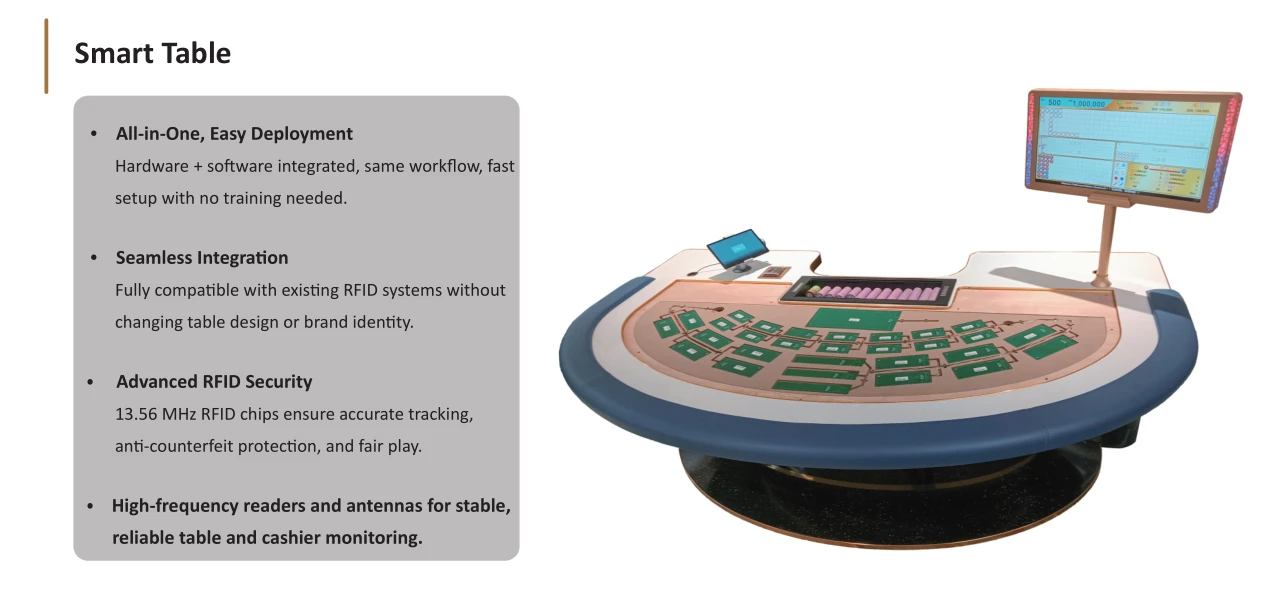
A baccarat RFID table features a network of antennas embedded beneath the playing surface, arranged to cover the dealer area, the Player betting zone, the Banker betting zone, and the Tie betting area. High-stakes tables often include additional antenna zones for commission collection areas and reserved high-limit betting spaces.
The antenna design for baccarat differs from other games because chips are frequently clustered in dense stacks and moved rapidly between zones. Engineers optimize antenna placement to read chips accurately through 15 to 20 chip stacks, using signal processing algorithms that filter noise and distinguish overlapping tag responses. The system updates chip positions 10 to 20 times per second, ensuring that every movement is captured even during the fastest-paced games.
Real-Time Chip Tracking in the Baccarat Workflow
When a player places a bet on the Player side, the RFID system instantly registers the chip count, denomination breakdown, and total bet value. This data transmits to the table controller and the casino management system before the cards are even dealt. The dealer no longer needs to call out bet amounts, and floor supervisors no longer need to estimate bet sizes for rating purposes.
After the hand concludes, the system calculates the correct payout based on the registered bets and game outcome. Automated payout verification compares the system-calculated payout against the dealer’s actual chip distribution. Discrepancies trigger immediate alerts to the floor supervisor and surveillance. In high-stakes rooms, this verification happens within milliseconds, preventing errors before the next hand begins.

Revenue Protection and Error Reduction
Manual chip tracking in baccarat is prone to dealer fatigue errors, especially during long shifts and high-volume periods. Data from multiple casino operators shows that RFID tables reduce dealer overpayout and underpayout errors by 85 to 95 percent. On a baccarat table with an average daily handle of $2 million, even a 0.1 percent error rate represents $2,000 in nightly losses. RFID systems eliminate the vast majority of these losses.
The system also identifies collusion scenarios that manual monitoring frequently misses. When a player and dealer coordinate to underreport bet sizes, or when chips are surreptitiously removed from the table, RFID tracking flags the anomalies. Pattern recognition algorithms analyze chip movement sequences and generate alerts when behaviors match known fraud signatures.
Player Rating Accuracy and Comp Optimization
Traditional player rating in baccarat relies on floor supervisors visually estimating average bet sizes and time played. Human estimation error in this process ranges from 15 to 30 percent, leading to both over-comped and under-comped players. RFID systems capture exact bet amounts and precise session durations, producing player ratings with near-perfect accuracy.
For casino marketing departments, this accuracy translates directly into optimized comp allocation. Players receive rewards that reflect their actual play value, improving marketing return on investment. High-value players experience more accurate recognition of their play, strengthening loyalty. Marketing teams can segment players with precision and design targeted offers based on actual betting patterns rather than approximated data.
High-Stakes Baccarat Room Deployments
VIP baccarat rooms present unique requirements for RFID table deployment. Privacy concerns require that player identities remain protected while chip tracking data is collected. Modern systems anonymize player data at the table level, transmitting only chip movement and betting data without associating it with personally identifiable information until authorized personnel access the data through secure dashboards.
The physical durability of RFID components is also critical in VIP rooms, where tables remain in continuous operation for 12 to 16 hours per day. Manufacturers design RFID baccarat tables with reinforced antenna substrates, industrial-grade readers, and replaceable felt systems that withstand heavy daily use. Scheduled maintenance occurs on a quarterly or biannual cycle, minimizing disruption to gaming operations.
Integration with Baccarat-Specific Management Systems
Baccarat RFID tables integrate with specialized baccarat management platforms that handle commission tracking, tie bet processing, and multi-table player session management. Commission calculations, which require tracking winning Banker bets across an entire shoe, are automated with perfect accuracy. The system deducts the correct 5 percent commission from each Banker win, eliminating manual commission tracking errors that cost casinos substantial revenue over time.
Tie bet processing benefits from automated resolution as well. When a tie occurs, the system identifies all Tie bets, calculates payouts at the correct odds (typically 8:1 or 9:1), and verifies that dealers distribute payouts accurately. Alert generation for tie bet errors has proven especially valuable because tie bets occur infrequently and are more prone to dealer mistakes due to their relative rarity in the game flow.
Multi-table session tracking enables operators to follow a player’s activity across different baccarat tables during a single visit. When a VIP player moves from one table to another, the RFID system tracks their total session value across all tables, providing a comprehensive view of the player’s activity that manual tracking cannot achieve. This capability ensures that comp decisions reflect the player’s total play, not just their play at a single table.
Vendor Selection Considerations for Baccarat RFID Tables
Casino operators evaluating RFID baccarat tables should assess several critical factors. Antenna coverage density determines whether all betting zones are tracked accurately, particularly in the corners and edges where chips frequently cluster. Reader sensitivity and anti-collision performance affect the system’s ability to read stacked chips reliably. Software integration capabilities determine how smoothly the RFID system connects with existing casino management and player tracking infrastructure.
Field testing before purchase is highly recommended. Operators should observe the system in live casino conditions, evaluating read accuracy with stacked chips, speed of payout verification, and alert generation latency. Reference sites with similar operational profiles provide the most relevant performance data. Requesting detailed performance metrics from vendor reference customers yields insights that vendor demonstrations alone cannot provide.
Commission management integration is a baccarat-specific requirement that not all RFID vendors handle equally well. Operators should verify that the vendor’s system supports their specific commission structure, including variable commission rates for different player tiers or table limits. The system should also handle no-commission baccarat variants, which are increasingly popular in Asian markets and require different payout calculation logic than traditional commission-based baccarat.
Scalability is another consideration for operators with multiple baccarat rooms or multi-property portfolios. The RFID system should support centralized monitoring across all baccarat tables while enabling local management at the room or property level. Cloud-based management platforms are becoming the standard for multi-property operators because they provide unified visibility and simplified maintenance across geographically dispersed locations.
Frequently Asked Questions
How quickly can an RFID baccarat table be installed and brought into live operation?
Installation of a new RFID baccarat table typically requires 4 to 8 hours, including antenna embedding, reader configuration, and software calibration. Retrofitting an existing table takes 2 to 4 hours. After installation, a calibration and testing period of 2 to 4 hours ensures accurate chip reading across all betting zones. Most operators schedule installations during off-peak hours to minimize floor disruption.
What happens if an RFID chip malfunctions and cannot be read by the table?
Malfunctioning RFID chips are rare, with failure rates typically below 0.5 percent annually. When a chip cannot be read, the system flags it as an unknown object. Dealers are trained to manually verify the chip and replace it with a functional RFID chip from the chip bank. The table continues operating normally, and the single unreadable chip does not disrupt game flow.
Can RFID baccarat tables operate without a network connection to the central server?
Most RFID baccarat tables include local data caching that allows them to continue operating during temporary network outages. The table stores chip movement data locally and synchronizes with the central system once connectivity is restored. However, real-time alerts and dashboard updates are unavailable during the outage period. Operators typically configure redundant network connections to minimize downtime.
How does the RFID system handle the rapid dealing pace of high-speed baccarat games?
RFID systems are designed to keep pace with the fastest baccarat games. Antenna read cycles occur 10 to 20 times per second, and bet registration completes within 50 to 100 milliseconds of chip placement. Payout verification happens within 200 milliseconds after hand completion. The system operates well within the time constraints of high-speed baccarat, where hands may complete in 20 to 30 seconds Macaumr Casino Supplier.
What is the typical cost difference between a standard baccarat table and an RFID-enabled baccarat table?
RFID-enabled baccarat tables cost approximately $8,000 to $15,000 more than standard tables, depending on the manufacturer, antenna density, and software bundle. Retrofitting an existing table costs $3,000 to $7,000. When factoring in the eliminated need for separate chip tracking systems and the recovered revenue from error reduction, the total cost of ownership is competitive for high-volume baccarat operations.